
Running in CI
Run BundleWatch in CI after your build. With a GitHub token, it posts a bundlewatch status on the commit and compares each file with the base branch. Your repository has to be on GitHub; the CI can be anywhere.
The examples below use bundlewatch.config.mjs from Getting started. BundleWatch discovers it automatically. For a custom filename or a file outside the search path, add --config <path> to the command.
GitHub Actions
On GitHub Actions, BundleWatch can use the token GitHub creates for every workflow run, so there is no token to generate or store. Add a workflow such as .github/workflows/bundlewatch.yml:
name: bundlewatch

on:
  push:
    branches: [main] # the branches you track
  pull_request:

permissions:
  contents: read
  statuses: write

jobs:
  bundlewatch:
    runs-on: ubuntu-latest
    steps:
      - uses: actions/checkout@v7
      - uses: actions/setup-node@v7
        with:
          node-version: 24
      - run: npm ci
      - run: npm run build
      - run: npx bundlewatch
        env:
BUNDLEWATCH_GITHUB_TOKEN: ${{ secrets.GITHUB_TOKEN }}statuses: writelets BundleWatch post thebundlewatchcommit status with the workflow's token. Keepcontents: readas well: apermissionsblock removes every permission it doesn't list.- The service accepts the workflow's token for saving baselines and creating short results links.
- The
pushtrigger lists only the branches you track. Otherwise a push to a branch with an open pull request would run the workflow twice, and both runs would post the same status on one commit. - The repository, commit, branch and pull request target are detected automatically, including the repository's default branch. On pull requests, the status goes on the pull request's head commit.
- Pushes to a tracked branch save their results as the new baseline. Pull requests are compared with the baseline of the branch they target.
Pull requests from forks
GitHub gives pull requests from forks a read-only token, so BundleWatch can't post a status on them, and logs a 403 error from GitHub instead. The job still fails when a file is over its maxSize.
Other CI providers
- Open service.bundlewatch.io/setup-github, signed in to GitHub as a user with push access to the repository, and authorize BundleWatch. The token has only the
repo:statusscope: it can read and write commit statuses, not your code. - In your CI settings, store the token as a secret environment variable named
BUNDLEWATCH_GITHUB_TOKEN. Never commit it. - Run
npx bundlewatchafter your build step. - If your provider isn't in the table below, or doesn't supply a value, set these variables.
Without a token, BundleWatch only checks maxSize.
Supported CI providers
BundleWatch reads the repository, commit and branch from these providers' own environment variables. Pull request builds are compared with a baseline but never save one (details).
| Provider | Base branch of pull requests | Counts as a pull request build |
|---|---|---|
| GitHub Actions | Detected. Other builds use the repository's default branch | pull_request and pull_request_target events |
| GitLab CI | Detected in merge request and external pull request pipelines | Those pipelines |
| Travis CI | Detected | Pull request builds |
| Drone | Detected | pull_request events |
| Buddy, Codefresh | Detected | Not detected |
| CircleCI | Not available | Builds of pull requests from forks |
| Netlify | Not available | Deploy previews |
| Cloudflare Pages, Codeship, Wercker | Not available | Not detected |
ZEIT Now (the legacy NOW_GITHUB_* variables) | Not available | Not detected |
Generic CI_* variables (CI set, no provider above) | CI_TARGET_BRANCH | CI_EVENT=pull_request |
Where the base branch isn't available, builds are compared with master unless you set CI_BRANCH_BASE. BundleWatch doesn't read Vercel's VERCEL_* variables, and some providers above don't supply the repository: set the variables below for anything that isn't detected.
Variables to set when they aren't detected
Set these for any value your CI provider doesn't supply:
CI_REPO_OWNER(e.g.facebookin github.com/facebook/react)CI_REPO_NAME(e.g.reactin github.com/facebook/react)CI_COMMIT_SHACI_BRANCHCI_BRANCH_BASE, the branch to compare with, if it isn'tmaster
See the environment variables reference for every variable BundleWatch reads.
GitHub statuses
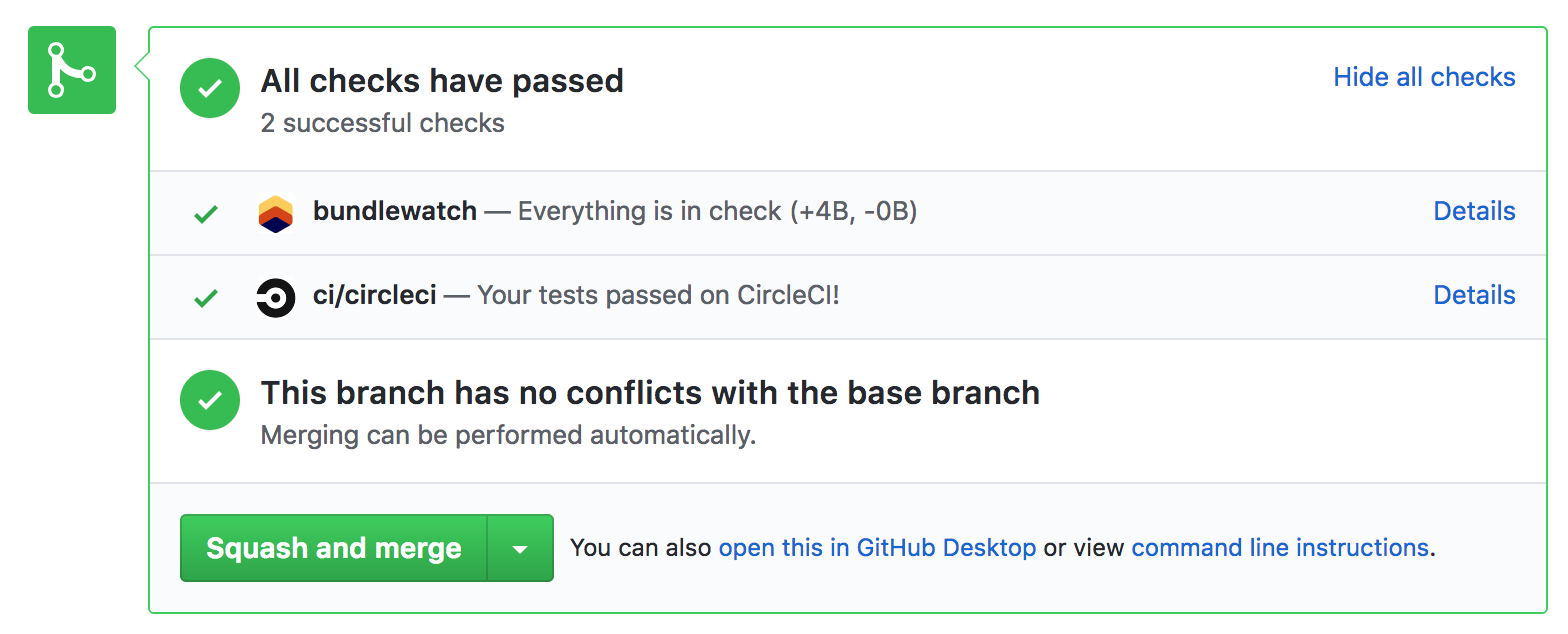
BundleWatch reports on the commit it checks, as GitHub commit statuses:
| Status | State | Description |
|---|---|---|
bundlewatch | pending | Checking bundlewatch... while it runs |
bundlewatch | success | The summary, such as Everything is in check (+1.2KB, -0B, +0.4%): the bytes files gained and lost compared with the baseline, and the change in total size. Without a baseline, every file counts as gained and there's no percentage. |
bundlewatch | failure | maxSize check failed |
bundlewatch | error | Unable to analyze, check logs. and the error, after an unexpected error. |
bundlewatch <file path> | failure | One per failing file, with its result, such as 198.6KB > 100KB (gzip). There's no description when the path matched no files or couldn't be read. |
- When there is a results link, the success or failure
bundlewatchstatus links to it. The other statuses have no link. - If GitHub can't be reached, a status keeps the last state GitHub accepted, such as pending: see Troubleshooting.
- Paths longer than 35 characters show as
*followed by their last 37 characters, with(2)added when two paths end the same way. - Descriptions longer than 140 characters are cut.
- At most five statuses per run:
bundlewatchand four files. The other failing files are only listed in the log and on the results page. - An invalid configuration is reported before any status is posted.
Statuses need a token, the repository and the commit. Without them, BundleWatch only prints its results and sets the exit code.
To block pull requests that make a file too big, make bundlewatch a required status check, in a branch protection rule or a ruleset of your repository. Require only bundlewatch: the per-file statuses appear only when a file fails.
Results links
Each run prints a link to its results page (Result breakdown at: …) and uses it as the details link of the bundlewatch status.
- When the service accepts your token for writing, the link is short, for example
https://service.bundlewatch.io/r/3fK9xQ2LmP7a. It accepts a token whose user has push access to the repository, or the workflow'sGITHUB_TOKENon GitHub Actions. The service stores the results and renders the page from that copy. - Otherwise the results are packed into the link itself:
https://service.bundlewatch.io/results?d=…. That happens without a token, with a token the service doesn't accept for writing, with a service older than 1.0, and when creating the short link fails or takes more than 5 seconds. For large projects these links can get too long for some browsers and servers. - With
bundlewatchServiceHost: null, no link is printed and the GitHub status has no details link.
Results pages don't check access: anyone with a results link can open its page, even for a private repository. A page shows the repository, branch and commit, and each file's name, size and limit. It never contains your token or your files.
Results page
The results link opens a page that starts with what the commit changed compared with the base branch: the bytes it adds and removes, and how much larger or smaller the files are in total.
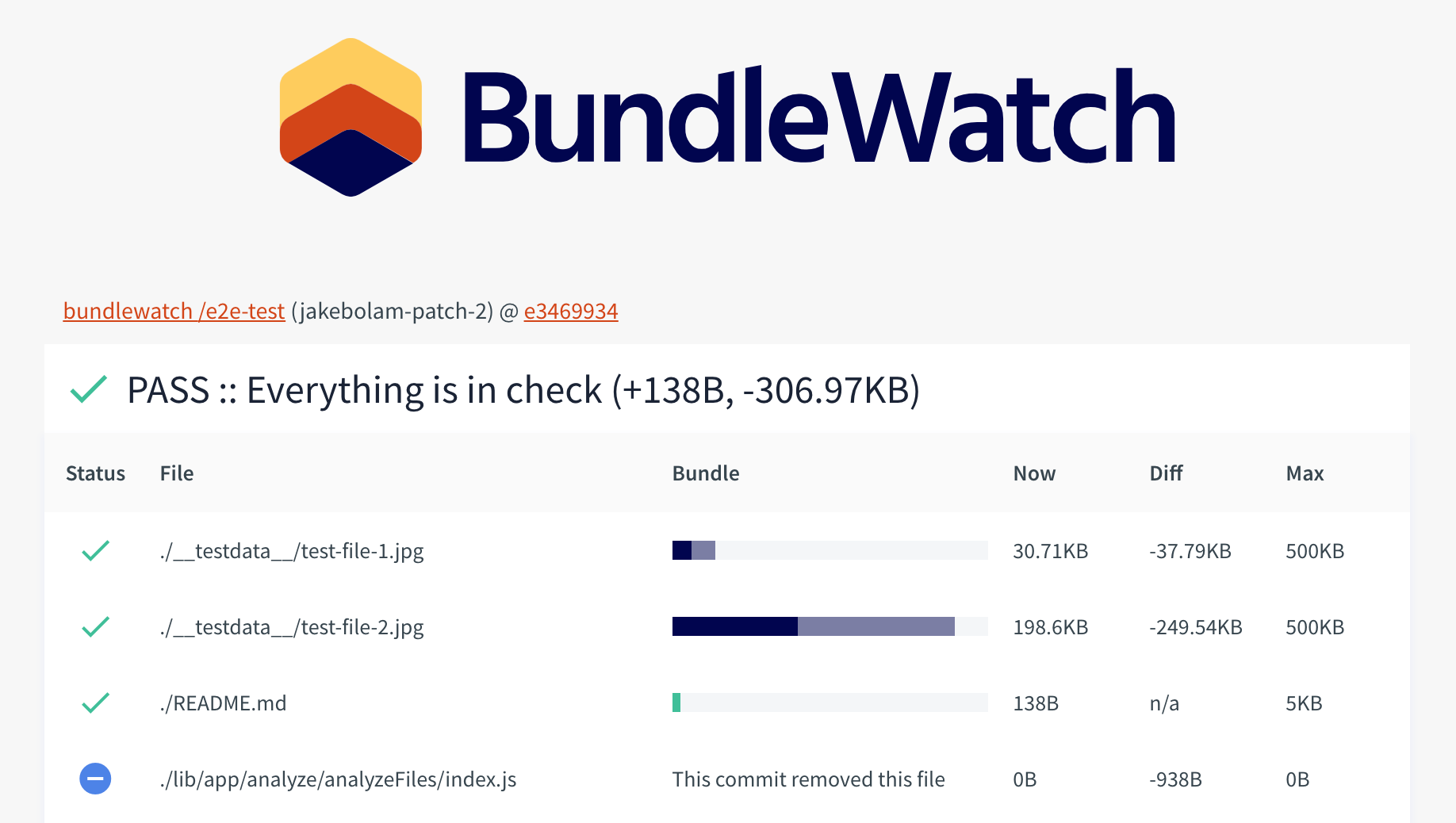
- Files are listed by how much they changed, largest first, each next to its limit. A file at 90% of its limit or more is marked. Files that didn't change are collapsed.
- Until the base branch has a baseline, files are listed by size against their limit instead.
- Paths that matched no files, or couldn't be read, are listed at the top with the reason.
- "All files" lists every file in a table: its size, its size on the base branch, the change and its limit.
A short link that doesn't exist or has expired shows "Results not found". A self-hosted service keeps short links for ResultsRetentionDays days, or forever by default.
If something doesn't work, look up the log message in Troubleshooting.